

Sheep among Wolves
Part 3 of Practicing the Kingdom

Hi everybody! Thanks for being here. Practicing the Kingdom is a series that explores how following Jesus reshapes our imagination, our desires, and our way of life. Today we’re considering the counter-cultural shape of Jesus-following culture.
The Woodlands is always free. Paid subscriptions are a gift. They help fund ministry to children, youth and adults in under-resourced communities.
Part 3: Sheep among Wolves
When she was a schoolgirl, my mother attended a mandatory mass rally in Linz, Austria. Schools had canceled classes. Teachers and administrators organized all the students and ordered them to march toward City Hall. Many of the children lined the approaching streets. Some, including my mother, stood looking up at a balcony waiting for the famous speaker to emerge.
It was March 13, 1938. Nazi Germany had just annexed Austria. Hitler had returned to his hometown for a triumphant speech. Between 60,000 and 80,000 people roared with approval. Two days later, Hitler spoke at the Hofburg Palace in Vienna. There he was cheered by nearly a quarter of a million people.
Six years later, the Nazis had imprisoned my mother in Mauthausen Concentration Camp.

You don’t have to be the child of a Holocaust survivor to find this story chilling. And like me, you’ve probably wondered how the Germans and the Austrians had so willingly, even enthusiastically, followed such an evil person into genocide and war.
To be sure, there were frighteningly wicked, sadistic individuals among the ranks of the SS and the Gestapo. But the vast majority of Germans and Austrians were pretty much like the rest of us. Decent people groping their way toward the good life. So, what possessed them to embrace the Third Reich?
In the decade following the Second World War, the philosopher Eric Hoffer pointed to the emotional and spiritual condition of the German and Austrian people prior to Hitler’s rise to power. The citizens of these countries yearned for a good life that seemed out of their reach. Disappointed, frustrated, and resentful, they welcomed a story that made sense of their circumstances and offered them a path toward reaching the kind of life they desired. (see his classic The True Believer)
Central to that story was the identification of a common enemy on whom all their misery and unhappiness could be blamed. So, they were bound together by a shared resentment and a common cause: eliminate the enemy.
“The cross stands as God’s (and our) eternal no to the powers of death, as well as God’s eternal yes to humanity”—Hauerwas and Willimon
Hoffer identified this dynamic in Nazi Germany, but people have formed themselves into groups around shared frustrations and scapegoats since there were people. Another theorist, Rene Girard, is well-known for identifying the pervasiveness of the scapegoat mechanism in human societies. And he also urges us to see that Jesus invited us into a radically different kind of community.
Jesus gathers his disciples, gathers us, into a community of love. A community that experiences itself as the beloved and so engages the world with that love. Like all human beings, we long for the good life. A life laced with meaning, enriched by belonging, and animated by purpose.
Followers of Jesus recognize that things are not as they should be. This world is marred and burdened by sorrow, misery, and wickedness. But we do not look for an enemy to destroy. We look for a wound to heal.
To echo Tish Harrison Warren, our way of being in the world makes Christian community profoundly counter-cultural. Even weird. This is what Jesus was getting at when he said, “I am sending you out like sheep into the midst of wolves; so be wise as serpents and innocent as doves.” (Matthew 10:16)
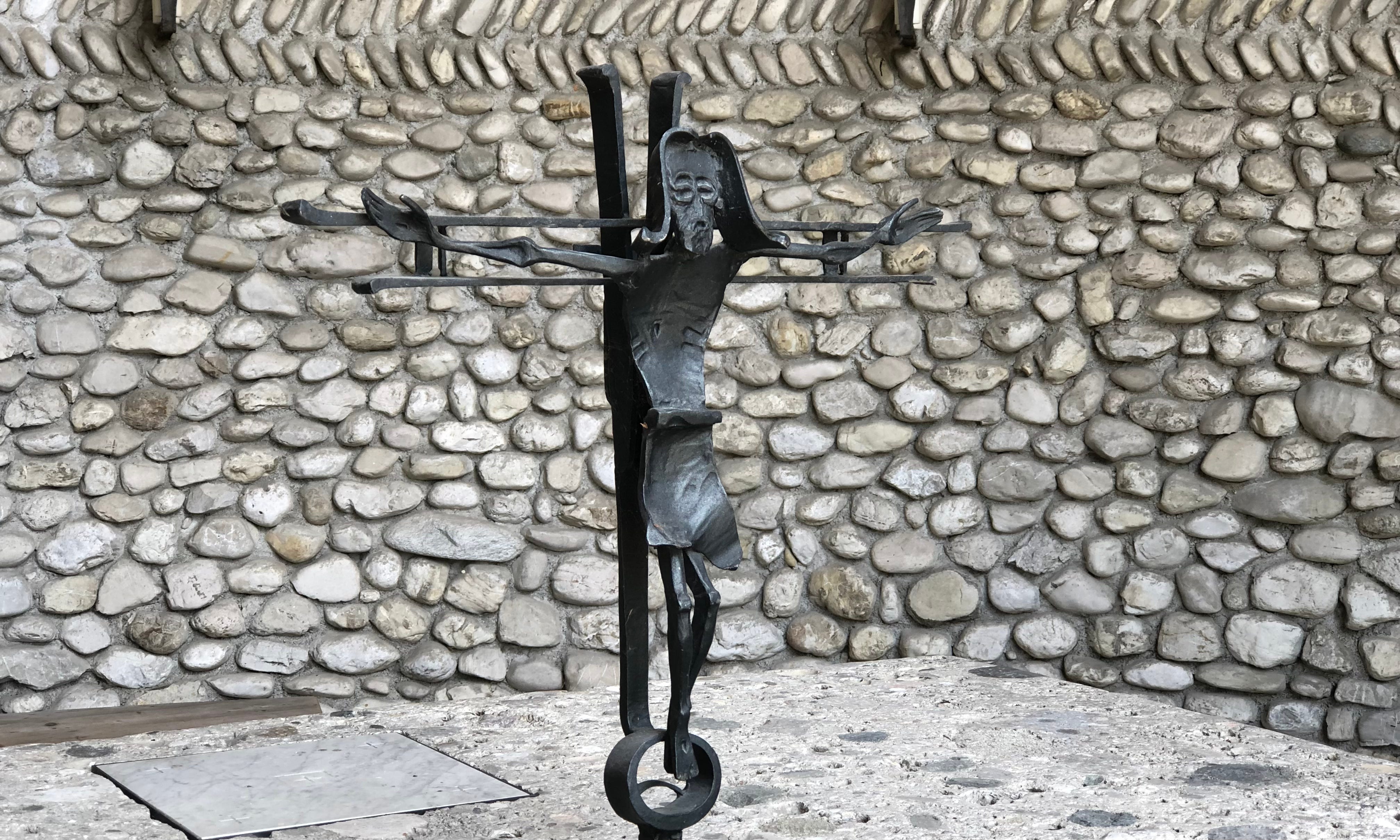
We are sheep. Our sense of belonging derives from the one who already loves each and every one of us. We are bound together by the common cause of embodying the Kingdom through the love we show for everyone, especially those ground beneath the wheels of the powers and principalities.
But let’s be realistic. We are sheep among wolves. The world is still dominated by those who seek out enemies to destroy. By wolves. Their way is the way of power and violence. And sure, Christians have endured and may again endure persecution at their hands.
And yet, there is a far greater danger for us. We can identify the wolves as our enemy. Our outward actions may not resemble theirs. But the patterns of our heart can become wolflike. Perhaps that’s why Jesus also said this: love your enemy. In other words, others may see you as and treat you as an enemy. Don’t return the favor.
Stanley Hauerwas and Will Willimon put it this way:
[The] cross is a sign of what happens when one takes God’s account of reality more seriously than Caesar’s. The cross stands as God’s (and our) eternal no to the powers of death, as well as God’s eternal yes to humanity, God’s remarkable determination not to leave us to our own devices. (see Resident Aliens)
My mother told me only once about being in that crowd in Linz. She remembered nothing about what Hitler said that day. It wasn’t like a celebrity sighting for her. More like a dull school assembly. Not exactly a highlight. Six years later the triangle affixed to her Mauthausen uniform designated her crime: antisocial element.
Spiritual Practice: Seeing a Neighbor
This week, when someone stirs frustration, resentment, fear, or contempt in you, pause for a moment and ask:
Can I see this person as someone loved by God?
Don’t argue with the question. Just sit with it for a moment.
Prayer
Lord Jesus, teach me to see others as you see them. Amen.
That’s it for this week. We’ll continue the series Practicing the Kingdom next week. Until then, be well and God bless.
Jake
P.S. You can contact my colleague Holly Davis to schedule me to speak at your event or lead a retreat. I love meeting readers in person and online. 2026 is probably booked, but there’s still space in 2027.
“we do not look for an enemy to destroy. We look for a wound to heal”. Amen
As you’ve stated, this scapegoating approach in which a “common enemy” is identified to rally the people has been used for centuries. Consider the Cold War, in which Americans were taught to fear ALL Russians or Communists. Even as a child, I wondered how ALL of a country could be bad people. Of course, it isn’t. It is so important to strive for justice and compassion in how we see others… and to resist the temptation to label ANYONE or any group as entirely evil.